Acoustic Correction Panels: How to Improve Indoor Acoustic Comfort
Acoustic correction helps improve the acoustic behaviour of a space by reducing reverberation and increasing acoustic comfort. Through the correct use of sound-absorbing panels, it is possible to improve offices, restaurants, meeting rooms, commercial spaces, public areas and residential interiors, integrating acoustic treatment into the architectural design.
Every space has different characteristics: dimensions, geometry, materials and intended use all influence the way sound propagates and is perceived. For this reason, effective acoustic correction is not simply a matter of adding panels to walls, but of assessing how much absorption is required, where it should be positioned and which solution should be used.
What is acoustic correction?
Acoustic correction includes all interventions designed to modify the acoustic response inside a room. One of its main objectives is to control the reverberation time, meaning the time during which a sound continues to be perceived after the source has stopped emitting it.
When the surfaces of a room reflect a large amount of sound energy, these reflections overlap with the direct sound. This can result in reduced speech intelligibility, increased acoustic confusion and, more generally, a less comfortable environment.
Acoustic correction acts on the behaviour of sound inside a room. Sound insulation, on the other hand, concerns the transmission of noise between different spaces.
How sound-absorbing panels work
Sound-absorbing panels are used to increase the acoustic absorption of surfaces and reduce sound reflections. Their effectiveness depends on the characteristics of the panel, the installed surface area, its position and the frequencies that need to be controlled.
For this reason, the number of panels should not be determined solely according to the size of the room. A correct acoustic design takes into account the entire space and its intended use.
Where to position panels for acoustic correction
Walls and ceilings are the main surfaces that can be treated. The choice depends on the geometry of the room, the arrangement of the furniture and the acoustic result to be achieved.
Panels can be installed directly on walls or used on ceilings with different fixing and suspension systems. Distributing sound-absorbing material across several surfaces makes it possible to integrate acoustic treatment even in environments where architecture and interior design impose specific constraints.
How many sound-absorbing panels are needed?
There is no single number of panels suitable for every environment. To determine the required sound-absorbing surface area, several factors should be considered:
- room volume;
- materials used on floors, walls and ceilings;
- glazed surfaces and other highly reflective elements;
- intended use of the space;
- number of people normally present;
- existing reverberation time and the desired acoustic result.
An acoustic assessment therefore makes it possible to define a solution that is proportionate to the actual requirements of the space, avoiding purely aesthetic interventions or approximate estimates of the amount of material required.
DO YOU HAVE A SPACE TO IMPROVE?
The configurator helps you describe your space and understand which acoustic solution may be most suitable. If you prefer, you can also contact us directly.
Acoustic correction and interior design
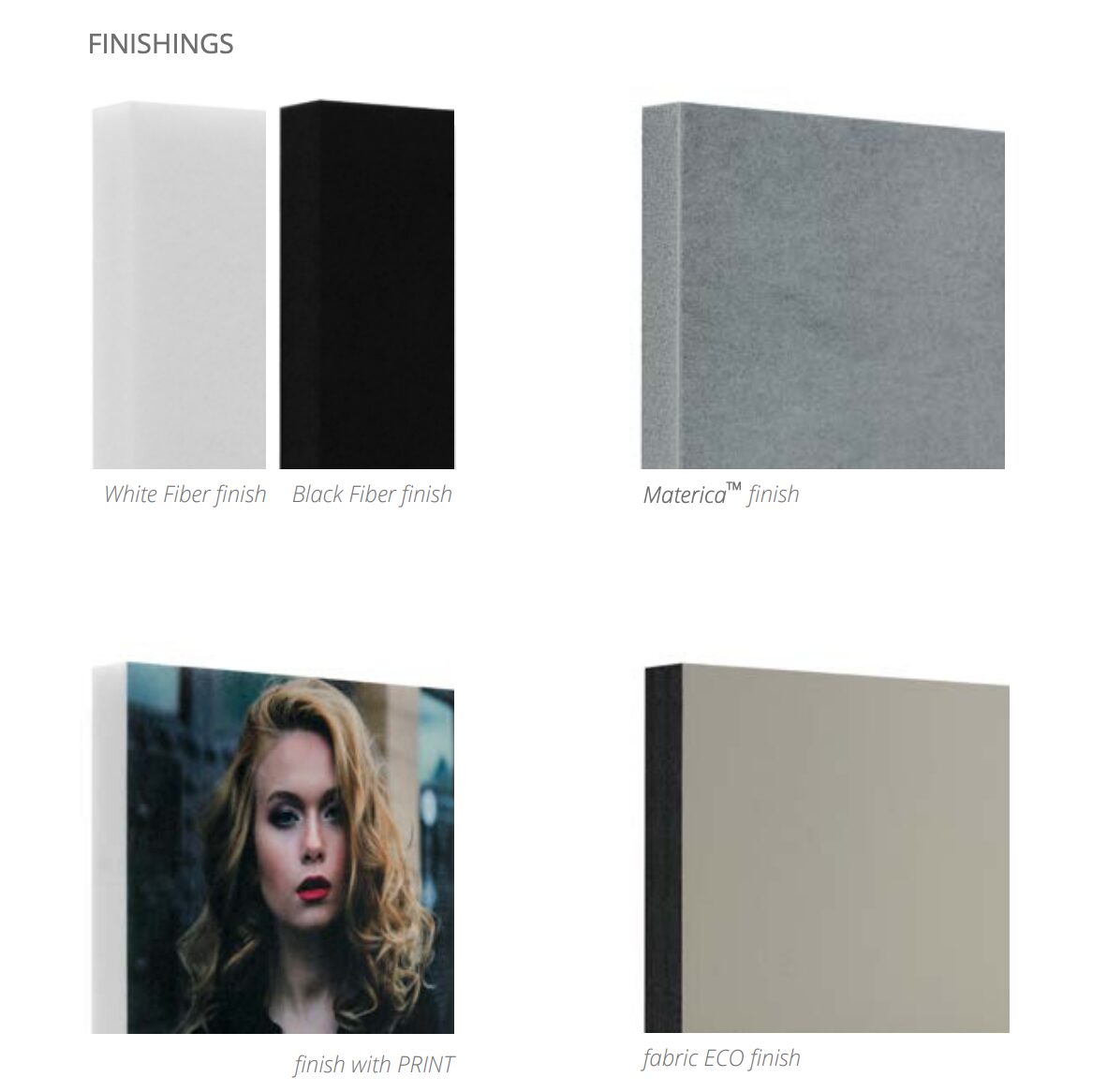
Acoustic treatment can become an integral part of the architecture. Garvan Acoustic panels are available in different configurations, shapes, finishes and colours, making it possible to coordinate the acoustic solution with the interior design.
In this way, the panel is not simply considered a technical element but can also contribute to the visual composition of the space through feature walls, decorative arrangements or ceiling installations.
The possibility of customising the solution makes it suitable both for new projects and for existing interiors.
The sound absorption coefficient
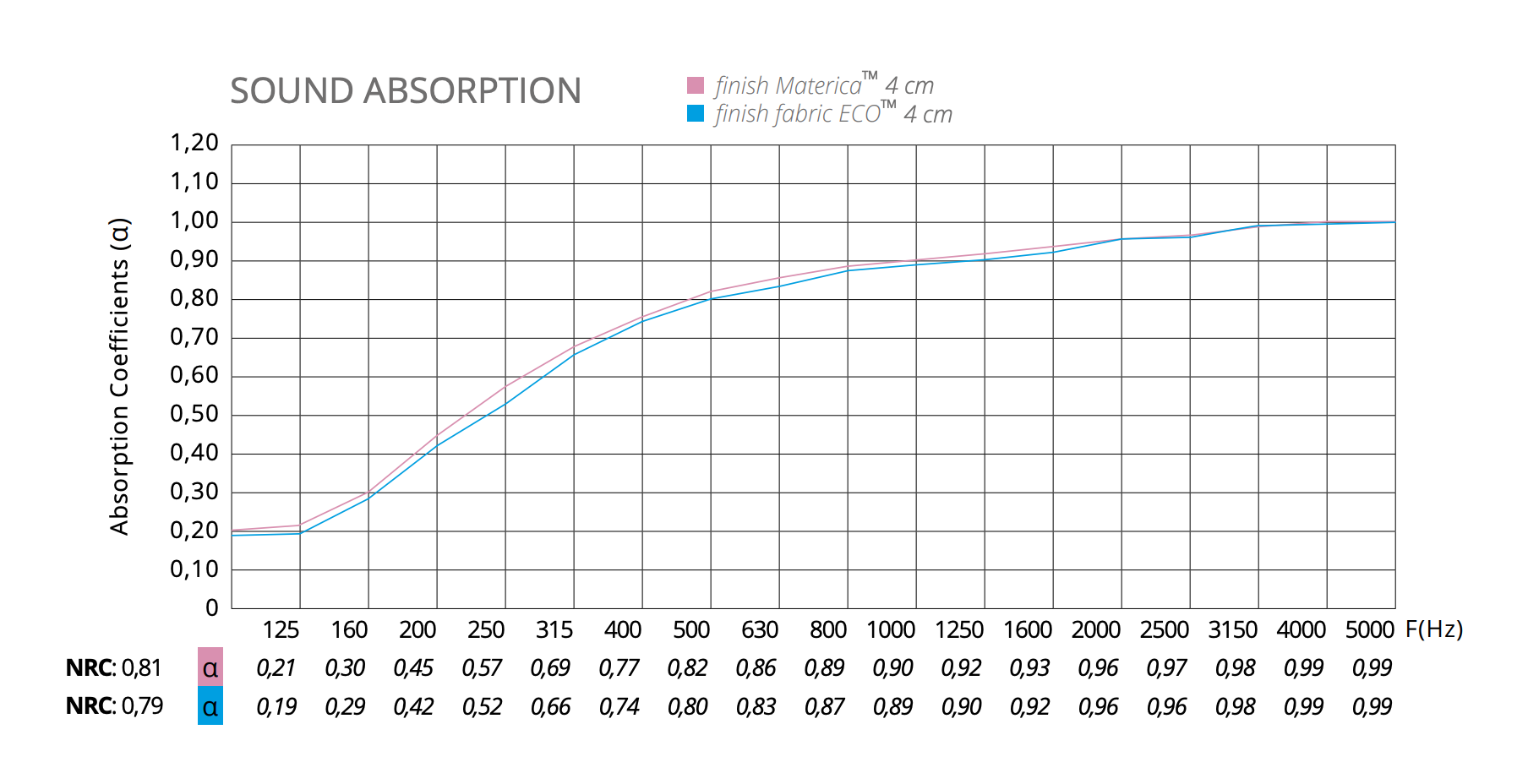
The ability of a material to absorb sound is described by the sound absorption coefficient α, whose value varies according to frequency.
The following graph shows the acoustic behaviour of Garvan Acoustic Surface™ panels with Materica™ and fabric ECO™ finishes, with a thickness of 4 cm, at different frequencies expressed in Hertz (Hz).
Acoustic correction: testing Garvan Acoustic panels
The video shows the practical effect of sound-absorbing treatment inside a room. The comparison helps demonstrate how sound reflections and reverberation can affect the perception of a space and the intelligibility of sound.
Where is acoustic correction useful?
Controlling reverberation can be important in many environments where communication, concentration or listening quality play a central role.
- offices and meeting rooms, where improved intelligibility supports clearer communication;
- restaurants and hospitality venues, where excessive reverberation can increase the perception of noise;
- commercial and hospitality spaces, where comfort and spatial quality contribute to the user experience;
- schools and educational environments, where speech intelligibility is particularly important;
- residential interiors, especially in spaces with large reflective surfaces and open-plan layouts;
- listening rooms and audiovisual environments, where the acoustic behaviour of the room directly affects perceived sound quality.
An acoustic solution designed for the space
Every acoustic correction project should begin with the actual characteristics of the environment. The sound-absorbing surface area, panel positioning, finish and installation method can all be defined according to acoustic and architectural requirements.
Garvan Acoustic develops acoustic comfort solutions integrated into interior spaces, combining acoustic performance, design and customisation.
Frequently asked questions about acoustic correction
What is the difference between acoustic correction and sound insulation?
Acoustic correction acts on the behaviour of sound inside a room, particularly on reflections and reverberation. Sound insulation, on the other hand, is designed to limit noise transmission between different spaces.
Do sound-absorbing panels block noise coming from outside?
No. Sound-absorbing panels are mainly used to control sound reflections inside a room. Specific sound insulation solutions are required to reduce noise transmission through walls, floors, doors or windows.
How many sound-absorbing panels are needed in a room?
The quantity depends on the volume of the room, the surfaces present, its intended use and the desired reverberation time. For this reason, the treatment should be dimensioned according to the characteristics of the space.
Is it better to install acoustic panels on walls or ceilings?
Both solutions can be effective. The choice depends on the geometry of the room, the available surfaces and the architectural project. In many cases, walls and ceilings can be used together to distribute the sound-absorbing treatment.
Further information on acoustic correction
To learn more about the design, installation and appearance of sound-absorbing systems, see also:
DO YOU HAVE A SPACE TO IMPROVE?
The configurator helps you describe your space and understand which acoustic solution may be most suitable. If you prefer, you can also contact us directly.


